|
Home Updates Hydros Cars Engines Contacts Links ←Previous Next→ Contact On The Wire |
June 2026
Of prime importance to the continuation of the various, competitive, model disciplines is firstly, new participants to replace the ever growing numbers that are retiring or no longer with us, and secondly the supply of suitable equipment for them to use. We have mentioned this on numerous occasions in past Pylons, but recently, two articles came to hand that covered the same ground, but with vastly different takes on it. The aeromodelling world is well catered for with a constant supply of new commercial models available, tethered cars less well so but still with the option to buy new and a few second-hand appearing. Those building their own are now few and far between and will become even more scarce.
New models are coming in, but the gist of this published discussion is what happens to those that that the new ones have replaced, or where the current owners have retired? The articles outline two possible scenarios, one is that models are passed down the line at sensible prices, and the other that they are snapped up by collectors who are prepared to pay way over the odds. The justification being that why sell a model to someone for £500 or less who will use it when it could be worth £2,500 or more to a collector or dealer on the open market? However there are some philanthropic owners who have passed on perfectly useable equipment, either for free or at nominal prices, but only to people that they know will use them. We noted that this is happening with the CMBL in France where models are being handed down and refurbished for youngsters to fly, as they would never be able to afford the same at market prices. Equally, tethered cars up to 40 years old are still competitive, as the very first cars registered back in the 80s are still holding their own, yet far too many have vanished into 'vitrine' as the Europeans would say because of the high prices they can command. We are aware of one competitor who has been systematically buying modern FEMA cars for many years but with absolutely no intention of putting any of them on a track (or passing them on, until the inevitable happens).
Both articles were written by competitors and enthusiasts who had spent a great deal of time, money and effort promoting tethered car racing by supplying parts and even cars. The first admitted that it was a thorny subject and some thought it 'offensive' that current race cars were sold to collectors for mega money, but he found nothing wrong with this. The second and opposing view was that there are hundreds of cars that could still be run now lurking in basements, attics, sheds and on shelves, that 'in terms of supporting the sport might just as well not exist'. Michael Schmutz intimated as much in his FEMA presidential address in 2023 when he suggested that current and past competitors pass on cars they were no longer using. A little aside that we have picked up is that new cars are being registered with old numbers so the originals seemingly vanish.
As a very pertinent aside, in late April a team from the CMBL, including juniors, travelled to Australia for the World CL Championships, what an experience and a way to encourage new blood? A sad reflection on the state of competitive aeromodelling in the UK though, as the entire British contingent was one entry in F2C, so congratulations to Chris and Neil for their efforts, but whoever would have thought that we could not manage a single entry in F2A, F2B or F2D for a World Championship?
A new Album, and continuing the theme from the last two months, a selection of cars from an extensive collection built up by another well known enthusiast who, sadly again, is no longer with us.
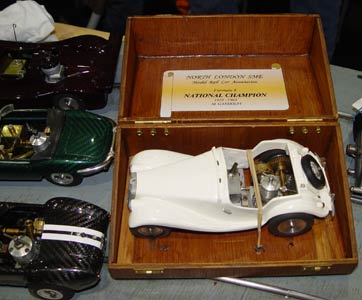
The Photo is another superb piece of modelling we were able to view from an enthusiast who specialises in detailed scale cars but with practical works underneath. It always surprised us that one of the most revered scale model Maseratis was just that, as there was absolutely nothing under the bonnet, not even a dummy motor?
Pitbox is a bit of an oddity as the items were found in a real pitbox that had not been opened for sixty years. A look back at how cars and boats used to be tethered.
Best laid plans as they say. No expectation that the report for the first BTCG meeting of the year could be published as we were due to be travelling to Switzerland on the first leg of our 'Spring Tour'. 5pm on Saturday at Buckminster and an email to say that technical problems meant that the Tell Race at Basel was cancelled, aargh. Massive session on 'tinternet on Sunday cancelling and rebooking travel and hotels, and suddenly a week at home to complete the report for publication. What was left of the Spring Tour is now published.
|
|
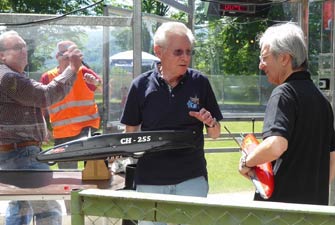
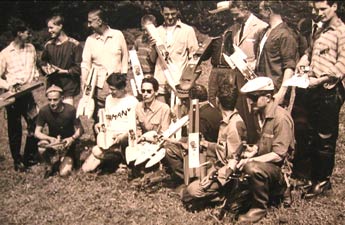
Empty Spaces: Gilbert Huguenin It was just under a year ago that Gilbert was taken seriously ill, shortly after Kapfenhardt and Basel, which would be his last track appearances. What makes Gilbert's career so noteworthy is that it spans no less than seven decades. In the centre bottom photo he is at a regatta with Paul Otto Stroebel in 1962 and bottom right, again with Otto in 2013. His prime interest was tethered hydros, right from the Flash he is holding, second right. Always resplendent in Alfa Romeo Supercortemaggiore overall, swapped for more natty shorts by the time of the three regattas in France. We were lucky enough to witness him winning the World Championship in A3, at Cestas only for him to retire, but come back almost every year thereafter. |
|
Although his forays in to tethered hydro racing occupied one trip a year he had, like Paul Otto and the late Stuart Robinson, moved in to running tethered cars, usually the latest 10cc model such as the Picco and the Russian carbon car seen here at Basel with long time racing partner Antonio Della Zoppa. Of the three hydro men, Gilbert was the only one whose hydro career lasted from the very early 1960s, right though to his last regatta in Bulgaria in 2024. A remarkable and seemingly unique, long lasting, connection with tethered hydroplanes. Our heartfelt condolences to Rose Marie. |
 |
 |
 |
 |
|
2013 World Champion A3 |
Paul Otto Stroebel 2nd left Gilbert 2nd right 1962 | Gilbert left, Otto right 2013 |
One very salutary realisation arose from writing this is that fellow competitors and people you shared time for several years with are no longer there, but there has been no mention of them either, so it is a shock to find that they are no longer with us, but their passing has gone unremarked.
May 2026
Over the last couple of years we have seen the break-up of many car, boat and engine collections, either through the death of the owner or a need (desire) to raise some liquidity, although this is far from the ideal time for this. In the course of discussions surrounding these collections, some interesting and widely differing opinions came to light.
There is a belief that at some stage collecting crosses a boundary and it then becomes more about acquisition and we are aware of several situations where this is definitely true where every room in large houses are full, and we mean full. This begs the question as to how many of something have to be acquired before the concept of a 'collection' is overridden. Lord Ashcroft's VC and GC collection made national headlines when he was told to remove it from the Imperial War Museum. Whether it is desirable for one man to own such a high proportion of these, or anything for that matter, is open to question, but they were on show to anyone who cared to visit the IWM, we certainly did? This led us to compare similar situations, both in our own sphere and other areas of interest.
The biggest collection numerically of any sort we are aware of is over 7,000 similar items, but these are in secure storage and won't ever see the light of day by anyone until the inevitable happens, and then imagine releasing that lot on to the market? To us it raises the important issue of how many do you have before you no longer know what you have? We have been quoted engine collections ranging from a modest 60 items where the story and history of each is probably known, right up to 4,000. There is even one hoard that far exceeds this but the owner does not have a clue as to what's there as everything is in boxes in the attic.
An even more bizarre case came to light last year when it was discovered that someone who had been buying items enthusiastically for a long while had never even opened most of the packages that they were delivered in. We were party to a similar case where the boxes had at least been opened, but that was as far as it had got, even after many years. It poses the question to us, that perhaps someone else can answer, as to why have all of this if you never see it, handle it, admire it or explore its history and provenance or intend to do anything with it?
To us a collection should be relatively focussed, with a reason for each item, whether it be obscure British engines, racing engines with important connections, or as in one case where items have proved winners and/or record breakers. Having recently been responsible for disposing of a large collection we did question as to why there were so many multiples of the same commercial motors? Even more so when there were also multiples of modern, reproductions of several engines.
The saddest of all is what was quite prevalent when things were dirt cheap where an individual would just hoover up as many of whatever they could with the intention of restoration or putting them on display, ranging from aircraft, traction engines, railway engines, cars, motor cycles and even tethered cars and boats, not to mention engines. Inevitably, most never were, slowly rotting in fields or decaying in barns and garages and now present a major investment to retrieve anything from what is left, if it even survived. We have had two very local examples that made the TV news, a field of rusting traction engines, untouched for nearly seventy years and a barn with twelve vintage Rolls Royce car wrecks that were going to be restored, but again remained untouched for decades.
The Pitbox goes some way to explore just how many kits for the Buck 2A were produced by Sid Smith of Pioneer Electra down in Chatham.
First of the event reports from the year with the SAM Spring Gala at Buckminster where the sun shone for most of the weekend, but strong winds precluded any flying. It was also the first chance to see a new and exciting tethered car being developed for use at Buckminster, as well as a first series of runs at over 90mph by a 2.5cc twinshaft powered car. A lot of changes at Buckminster with the building of a permanent shower and toilet block on the campsite, and a different regime in the cafe with the retirement of Gill. Next event at Buckminster, Tether Car Group three day meeting 8th,9th,10th May
Steve Betney has been suffering of late, which has restricted his travelling to Buckminster, but he has been able to continue with his modelling. His output has been prodigious, but always with attention focussed on scale details and adherence to original drawings. His latest, that he has kindly shared with us, is a model of a 1927 Delage, very much in the style of the cars built by Bert Pearson, Bob Grey and others, with superb bodies on fairly simple and easily built chassis.
Confirmation from Boris Astrom that the SMRU website has closed permanently and the organisation is currently looking at alternative internet provision.
Peter Hill called time on Retro Club events at Gt Carlton in 2022 but decided to try the concept of a 'Revival meeting' in 2026. Although the weather was fine and sunny, it seems the appetite for true 'Retro running' is diminishing, as those enthusiasts left and still able to travel are becoming increasingly few and far between, not an uncommon factor in British modelling circles unfortunately.
Empty Spaces:
|
|
Ake Ekstrand
Very delayed news via facebook
and thanks to Boris Astrom.
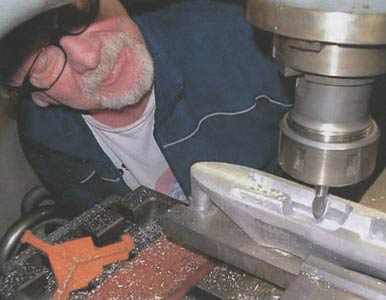
Although we had never met him, Ake had a long standing connection with British tethered car racing. It was with one of his cars that Stan Barrett established a British 1.5cc record that stood for many years, until broken by Aaron Monk with another, extensively modified, Ekstrand car. His EX, EEX and EXTRA cars appeared over several decades in the 1.5cc and 2.5cc classes run by him and several of his Swedish compatriots. It was one of Ake's cars that gave OTW the first taste of international tethered car racing in 2013 and two of his 2.5cc cars currently appear at Buckminster. By profession Ake was a craft teacher and a consummate engineer, producing many cars over his long racing his career that spanned nearly five decades. He was a serious hunter and also a skilled craftsman, making the most exquisite hunting knives. Left: Ake machining a 2.5cc Extra pan |
April 2026
Purely in the interests of information gathering we regularly delve into Facebook posts and ebay listings, just to see what has come to light. American cars were produced in their thousands so make up the bulk of what appears, British and continental cars less so, and a far higher percentage were home built and subsequently more difficult to identify. Very few hydroplanes were commercially built so identification of these also tends to rely on detective skills. With engines it is the opposite case as these were coming out of factories by the truckload, so it has to be something very rare or unusual that defies immediate identification.
A well known, UK, fine art, auctioneer said recently that with any item that comes into his sale room he wants to know 'what it is' , 'who made it', 'when was it made' and 'is there any known history' before any realistic estimates can be established or a catalogue entry prepared? This very much tallies with our train of thought and reasoning. Conversely, the first question that most now seem to pose in their posts, and in email enquiries to us, is 'what's it worth'? An almost unanswerable question until the auctioneer's four questions are answered. Even so, what it is worth and what it could be sold for are now two totally unrelated concepts. There is an old adage that 'it's only worth what someone is prepared to pay for it' and what it might have realised a decade ago is probably now very wide of the mark? See the comments below after the latest BMFA auction. Two recent posts and an email summed all this up succinctly as there were tables absolutely full of assorted items and the question, what's it all worth?
There are the alternative posts where an owner is looking for parts to restore or complete a particular car or engine, a desire we can well associate with. Less common, but of increasing interest to us is an item that we are well acquainted with but now turns up with a different owner. Not a real problem except when the previous owner has categorically stated that 'it was not for sale' as they intended to keep it. Most aggravating if it happens to be an item you originally sold cheap or as a favour to help out, as a number of our contributors have experienced? As many have found to their cost, once you have parted with an item you have absolutely no control over what happens to it, and that applies equally to football clubs, multinational companies and us with our more modest items. We are in regular contact with one owner who would like to sell their father's instantly recognisable and famous cars along with a very extensive archive, worth a considerable amount of money, but are equally aware that once this happens it could all go anywhere in the world or be split up. This is not acceptable to them and at present a dilemma that is, as yet, unresolved after several years. An interesting alternative was a sale with a strict proviso that the item could not be sold on but would be offered back to the original owner to buy back. This, of course, relies entirely on goodwill and honourable intent, not always present in some areas?
The Pitbox is another example of our favourite finds, a car that was photographed and described in detail in the very early 1950s, but then not seen since, until now.
The last of the tales from the Garret Workshop until next winter relates to the Rowell update published in February that cast a whole new light on a build completed several years previously, but largely sidelined as it was not considered to be an original car.
Activities get underway at Buckminster this month with the SAM Spring Gala on the 11th and 12th of April with the first of the swapmeets on the 12th. The following Sunday, April 19th, is the Retro Racing Club Revival meeting at Peter Hill's Gt Carlton Raceway. Grass area for caravans or motor homes overnight, along with toilet facilities. Free tea, coffee, and even wine on offer. Substantial number of tethered cars will be for sale from Peter's collection, along with spares and other items and opportunity to add your own sales to the tables.
The mind continues to do a lot of boggling. Just a few months ago we were astounded when a single Corgi model sold for over £22,000, but that has been surpassed by a single Pokemon card at £30,000. Add the £7,500+ commission and the £1500+ VAT and that is one expensive piece of card, especially as it came with 10 others for £2.00 in 1999. Imagine getting caught for the capital gains on that! The worst bit, the boxes or plastic wrappers on these figures, cards, toys etc can never be opened as the value would plummet. Bit like old wines that sell for thousands and can never be drunk? Who says tethered cars and engine are expensive, and we can use them?
A short report this time from the 3rd International Swapmeet in Germany by courtesy of joint organiser Amadeus Kurz. Unfortunately our usual tethered car contributors have not posted or sent any material so the report is almost entirely composed of the range of exotic motors on display.
Following on from last month's Pylon, we have had to have another trawl through our links page as so many of the websites we included have either vanished and not been replaced, including one national authority, and others that have not been updated for several years, again difficult to understand when they are current club and national associations. Some we have retained for their historic content, but others have now been deleted.
Very interesting results from the BMFA auction last month. The very rare still sold for reasonable money, the more common could hardly be given away and surprisingly, modern NIB replicas, including Arne Hende way below what they were just a short while ago. Two genuine Yellow Jackets were disappointing (except for the buyers) but the real eye openers were the miniatures, including Hende and some of unknown origins, which went mad. High points of day one were a very early Baigent ERE, one of only two Dyne sideport engines ever to emerge and one of the very first OPS wart 60s produced by Picco in the 1960s. So early was it that it did not even have OPS cast in, just hand engraved lugs. Surprises do lurk when we have to assume that bidders know something we lesser mortal don't such as a seemingly ordinary Cox that just kept going and going. Many of the lots sold at just on or below low estimate and later lots illustrated that reserves now have to be much more realistic?
The Market Place page continues to attract buyers from around the world so it's worth giving it a go if there are still items lurking that you would like to see gone? Only one item left from all of March's ads so plenty of clear space to get your items noticed.
Some remarkable performance at the Brisbane International including new national records. As at Buckminster, the Australian meetings use nominated speed to decide their major trophies, this year won by Thomas Finn with an error of, yes its correct, 0.010mph. Not so many international competitors this year for obvious reasons but Charlie and Kelly Murphy made the trip from the States, Thomas and Paul Otto Strobel from Germany and Switzerland along with Tonu Sepp and Rain Teder from Estonia. Full results available on speedmodelcar
March 2026
Just recently, an almost complete collection of AMRCA newsletters have come our way, which make for very interesting reading, especially as they are in English, unlike the old FEMA versions that required studious use of Google translate. It is a reflection of where we are in this technological age that these, along with earlier French, Swedish and Italian magazines, contain the only detailed records of tethered car racing in the modern era. One by one though, the printed journals, commercial or those printed by organisations have foundered, so that contemporary information and reports are now sketchy. Websites have been set up by individuals such as ourselves, clubs and organisations, yet a quick scan through our links page reveals how little material some contain, and worse, how infrequently, if at all, they are updated. Fanny Krasznai has done a super job with the FEMA website in digitising European results back to the 1950s, but these do not tell the whole story that a magazine or newsletter can.
Several years ago now, one of the leading British hydroplane competitors asked why we were so 'obsessed with the past', and more recently the statement from a car enthusiast that they 'were not interested in anything old'. To us it is important, as understanding of what went on in the past gives a vital insight in to where we are now. Both via OTW and as individuals we often faced with questions relating to boats, cars and engines as to 'why a situation, rule, design or piece of equipment exists'? The answers might not always be logical, or sometimes not even remotely sensible when looked at in hindsight, but the decisions were made through commercial considerations, consensus, or on odd occasions by those that ignored the existing rules and were not taken to task. This is where reference to the archives is invaluable as it can often pin these changes to a particular date or period, along with the reasoning and justification for them (if it exists). Some, like the banning of fuel additives was in direct response to the health dangers inherent with some of the witches brews being used, some through safety considerations, whilst others have resulted in the conundrum of 'the law of unintended consequences', that can change a sport for ever, but not necessarily in the way it was supposed to. Like with so many things, once there is the realisation that 'this was not what was intended to happen' it is almost always too late to do anything about it.
Even more important for us is that magazines remain, along with all the material they contain, plus thousands of images with captions, as a valuable source of reference. Social media is now the choice of most for posting images, and whilst they are a wonderful record of an event, without captions they are largely meaningless. Mind you, we had the same problem with the vast majority of the several thousand images that we have been lucky enough to become custodians of. Just a few have had captions on the back, but for most, it has been a matter of cross referencing the images with what has been published in print or calling in favours for an identification of individuals or equipment. Many, however, still remain something of a mystery.
Magazines are also a wonderful source of news, 'gossip', speculation and asides about personalities, developments and projects, whilst the 'sales pages' can reveal a great deal about the provenance of equipment. Even the commercial ads provide vital material, again missing entirely from web based or social media sources. We don't dismiss these new avenues, as an ad or a simple request for information reaches all round the world and will usually result in plenty of replies, but like much in life now, not always accurate? That is not to say that the printed resources are any better as we have found. The Engine A-Z contains a number of errors that are repeated by those less well informed, especially at non specialist auctions. Spindizzies also has errors in captioning that resulted in a wonderfully speculative ebay listing and someone paying an inordinate amount of money for a car illustrated, except it wasn't. Just last month we found that the list of models produced by a famous engine builder, published by him, reproduced and circulated around the world and used for reference by many is actually incomplete. This caused all sorts of problems along the way proving the provenance of engines that had appeared but were not listed, that is until a private individual published the missing details many years later. Even the Aeromodeller managed to create wrong captions in an article which caused confusion, annoyance and embarrassment in equal parts.
One absolute advantage that printed material has over the digital was illustrated just a couple of months ago when one of the very best, most informative and probably most accessed modelling website in the UK suffered an electronic glitch. The result was that it, along with all the material, thousands of informative and helpful posts, hundreds of pages of digitised material, information, plus untold hours of work just vanished, unfortunately it seems, for ever. We are already mourning the loss of this site as it provided such a valuable source of historic material. We do hope it can be recovered as it is unlikely to ever be replicated?
One little gem we picked up along the way that again ties several elements together was the announcement of the formation of the Derby Club. The Secretary was named as E.W. Fletcher with an address given as Warren and Clarke, the foundry that supplied castings for Ian Moore's and other designs. It also indicates the origins of the 'Warren Trophy', wonder if that still exists somewhere?
The Pitbox this month unfortunately is again the result of a long time contact and extremely knowledgeable enthusiast not being in the best of health. The car is a relatively common model but built and set up in a most unusual way.
Our Market Place page has an advert for the sale of many of the rare and one-off Oliver aero motors that came from the same collection as the twinshaft car motors, an extensive collection now being disposed of.
Long Lost Tracks returns but oddly with a track in the UK that is very much still in existence, just disused for around fifty five years. Possibly the only UK track that is still intact? What has made this an even more informative entry is that we have been kindly sent memories of the track from two current racers who were there, as well as photos of two cars that ran there in the 1960s and are still run regularly.
Further news about the Retro Club Revival meeting on the 19th April at Gt Carlton. Peter Hill has informed us that, as well as a clear out of spares and other items, he is rationalising his extensive collection of tethered cars. As a result there will be a number of complete cars and projects for sale on the day. No prior lists, you will need to be there to take advantage of what is on offer.
The flabber continues to be gasted. Just goes to show that trying to predict the tethered car market at present is a lottery. Bare M&E chassis with Special and Challenger bodies at SAS auctions, estimated at £200-£300, hammer price £3,600, £4,600+ with premium and VAT, wow. It did have a box of odds and ends with it though that included of all things, an original twin cell NIFE alkaline battery that was fitted as standard to many cars of the period. An E&M Maserati, more or less complete with motor, clutch drive train etc. got out for £1,800, which seemed about right, although £2,250+ with premium bumped that up. It appears that the more scale M&Es are still selling for premium prices but this was the most expensive of those without a motor or any other internal parts. The most expensive so far at auction was over £6,000 hammer price with the oddest motor fitted, an ED Penny Slot 2cc diesel. Strange to think that just within the life of OTW M&Es are making well over 100 times what they were?
Market Place kicks off with an eminently useable car for Buckminster, a ready to run, tried and tested 2.1cc Junior car that has already recorded speeds near to 100mph.
When Ian Harper took over the supply of original Oliver castings these were either semi scale cars from the late 40s or non scale race models. John Goodall believed that there should be cars from a later period that would compliment the range and follow in the 'Oliver style' for twinshaft motors. Having created the 1957 Vanwall he described last year, he has now modelled the P25 BRM with the same level of scale detail that he puts in to all his cars. This time though there is an entirely new and much easier to install suspension system, both front and rear. Thanks John for yet another detailed article and addition to the 'Oliver range'.
Important Note: As usual, 2025 event reports will be removed this month to make way for the new season. Please feel free to download and save any that are of interest.
Empty Spaces: Unfortunately, even more long time modellers and personalities join our list of empty spaces with Ken Daniels who was an officer of the MPBA for many years as well as a talented, multi discipline modeller. Closer to home was Arthur Wall who had featured in our 'Who's Who' of tethered hydroplane racing for his exceedingly long and successful racing career. The news did not get any better as the month went on as one of the great engine men and team race pitman/mechanics Taffy Bollen became the latest addition.
Taffy Bollen:
|
|
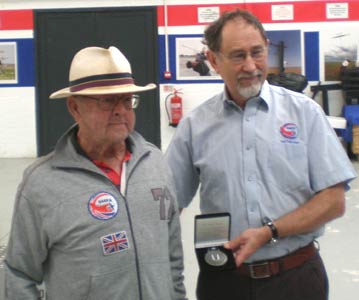
Taff was a name well known to us for many years before we ever met him. His record for team racing and engine preparation was legendary for decades, so it was a great pleasure to finally meet up with him. Initially when he began to accompany his sometime pilot, Dave Smith to hydroplane meetings and later to Buckminster where Dave was putting their combined knowledge and skills in to running an aircar. Taff's greatest claim to fame was his ability to make engines go quickly and his amazing skill in taking any engine and transforming it completely. He would have bags full of these modified motors to show to interested parties, especially as always significantly faster than when original. Our favourite 'Taff story', of which there were many, and this was told to us by him was when a bystander was waxing lyrical to him about the tuner who was 'ruining the sport' by producing one-off motors that were so much quicker than anyone else's. Who is this doing the damage he enquired, Taff Bollen was the reply, ah, that's me said he. The rest of the conversation is best not repeated. |
Long time friend, pilot and noted speed flyer, Dave Smith, has very kindly sent us this personal appreciation of Taffy
|
Taffy Bollen was a positive person and a joy to be with. His super personality always shone through and he was always helping people achieve their goals. A diminutive presence camouflaged his real talents until you got to know him. Taffy's first love was racing self tuned motor bikes (undoubted knowledge gained here assisted his future projects). Team Racing was Taffy's main aeromodelling activity though, over the years he flew with a number of pilots, I was lucky enough to fly with Taffy for a few years, attending meetings in the UK and abroad. I will always remember flying in a wonderful International in Portugal hosted by Julio Isidro. During the Vintage 1/2A final I had the audacity to shout out as we were coming in for a pitstop (turn up the comp)! He arrested the model stood up and yelled, you look after your ----- end and I will look after my ---------end!! A quick tweak of the needle, the model launched and we won the final. Taffy was highly delighted to be presented with a Special Award ( at the British team race Nationals held at Buckminster 2025) for his contribution to team racing and engine work. I could go on for ever reminiscing . |
|
February 2026
Something of a 'bumper' edition this month with several updates, discoveries, a revealing document and a visit to a 'long lost track'. Thank you to everyone who has sent us material to contribute to this and future editions.
We are going a bit 'left field' this month as we are having a one-off look at rail track racing. This may not seem immediately relevant to tethered car racing but, contrary to statements in the Laidlaw Dickson book, rail racing actually preceded tethered cars in the UK by nearly twenty years. It was also largely responsible for the rapid demise of tethered car clubs and tracks when many enthusiasts took issue with what correspondents called 'the pursuit of speed'. The net result was that, apart from Mote Park, tethered car racing in the UK was moribund by the end of the 1950s yet rail track racing continued for many years after, before in turn being sidelined by slot and RC cars.
It is ironic in a way that the first rail tracks here in the 1920s were electrically powered, multi lane and intended for public entertainment in the amusement arcades and exhibitions of the day. The late thirties saw the growth of model car racing with elastic and clockwork powered cars run off against each other on a straight track. The arrival of tethered cars in the UK was a direct result of the ban on model aircraft and organised hydroplane racing in WW2 as recounted in past articles. By the end of the 1940s the tide was changing as many of the pioneers were embracing railtrack racing with clubs springing up all round the country, just as fast as the tether car clubs and tracks were closing.
The first to change tack were members of the Pioneer Club who had led the way with tethered cars becoming the 'Raildromers' with Jack Gascoigne and Jack Morgan as prime movers, followed by the North London Clubs 'Nordromo' in June 1950 led by Arthur Weaver, the Meteor Club with Gerry Buck largely responsible for the construction and Figure Of Eight in North London with their portable track. Each of these clubs had tracks by the end of 1950 followed by many others through the 50s and well in to the 60s with Portsmouth having a huge outdoor track on the seafront. OTW well remembers the tracks at the ME exhibition with multiple diesel cars running indoors when you could hardly see across the room for smoke, and as for the fumes, no 'elf and safety' in those days?
Inevitably, numerous commercial companies such as Walshaw, Henri Baigent and Albon Adams with MRRC started supplying smaller cars and components for this new activity with dozens of published designs including examples by Gerry Buck and engines from Weaver/Ransom. Initially cars had one set of fixed guides under the front of the car but soon these became pivoted controlling front wheel steering, later, a second set added at the rear allowed a level of drifting followed by clutches in each drive wheel and even rudimentary braking. It was the design of these guides and the rail configuration that led to the long and bitter legal dispute that we outlined in May/June2025, eventually resolved and with the system remaining in use to the present day.
Most railtrack activity finished in the late 1960s although a small group of enthusiasts continued running at shows and exhibitions until just recently. Those who visited Old Warden will remember the portable track being used by Bill Langley and the Gandolfi family.
The popularity of rail cars over the twenty year period means that they often appear for sale, early commercial home built ones and the more modern models. Interestingly, tethered cars started off with scale looking cars before moving to out and out racers, but the rail cars adopted and maintained a more scale approach to the end. Rail racing in the UK was a very different beast to that in the USA, here 1-1.5cc diesels, there, full on 10cc Nitro cars with two sets of fixed guides on the side of the car running side by side on heavily banked board tracks.
The Pitbox then is a rail car, but more than that, a very recent discovery, not seen for more than seventy years and a model of a well known full sized car, the perfect Pitbox in all respects.
A whole raft of new material and updates over the next few months, starting with a trip that members of the Swiss Model Car Club made to the site of the original Landikon track. Amazingly, the track is still there, buried under top soil and the layout clearly visible. The site is privately owned and fenced off, but the current owner allowed access and photographs to be taken, which the SMCC have kindly shared with us. In addition there are images from when the track was in use, taken by a competitor at the time.
The next update took a bit of head scratching as all the files sent were in HEIC format, which nothing we have can deal with. Eventually we managed to convert an amazing collection of images that we can now publish. The background to the late Alberto Dall'Oglio's foray into tethered car racing has already been published but Gianmauro Castagnetti has obtained the entire Dall'Oglio AD09 project, cars, engines, tooling, dies etc., which he has shared with us, thank you Gianmauro.
Final update for this month is to the history of the Rowell company as a result of material sent to us by Philip Johnson, whose father was a speed flyer and tethered car enthusiast up in the North West. Firstly a Rowell 60 bought by his father, still in its box, with the most complete set of paperwork we have ever seen, but with an extra printed page that resolves a seventy plus year old conundrum as to why a Rowell Sabre car has never turned up in all that time, the simple answer, because it never existed as such. The update reveals this fascinating and up to now, unknown information.
A new and occasional series begins having persuaded the inhabitant of the Garret Workshop to continue his tales. Not so much 'how to do it' articles, but more his musings, trials and tribulations along the way and the odd titbits of information.
Market Place returns after a quiet couple of months with two eminently desirable 'Wilma' 3b cars. One almost totally original, with history and ready to run and the second, mostly original but a project. Ideal for Buckminster as they still have the original MAC motors so not too 'peaky'.
The dates for the World tethered hydro championships have been confirmed to be held at Pazardzhik Bulgaria from 18th-23rd August. This has been added to all the other dates on our Calendar page
We often comment on the amazing prices realised at auctions for modern collectables, but an item at Vectis just beggared belief. An ordinary Matchbox toy car that reached a hammer price of, wait for it, £20,050. Add on another £6,000 plus in commission and VAT and that is one very expensive toy?
Peter Hill has announced the date for the Retro Racing Club Revival meeting at Gt Carlton. Sunday 19th April. Plenty of parking and space for motor homes, toilets, free tea and coffee and free to run on the track. In addition, Peter is having a massive clearout of car related items (and cars) for a one off, king sized table top sale. Visitors are invited to add anything they want to sell to the mix as well.
Empty spaces:
|
|
Mario Gandolfi The name will not be known to most, but Mario Gandolfi was one of the leading rail racing exponents through the 1950s and well in to the 1960s, winning numerous events along the way as well as becoming National Champion. We used to meet him at old Warden where he would be running cars with his son Carlo and Bill Langley. The cars had moved on somewhat with carbon fibre bodies and modern motors. Mario was a font of knowledge and helped us a great deal in the early days with his reminiscences, yet it was somewhat of a surprise when he revealed that his core business was nothing to do with engineering or modelling but with the company bearing his family name that produced ballet and dance shoes along with costumes and show gear. Mario died just before Christmas in his late 90s. Shown here in 2017 is his Championship winning MG along with the carbon bodies cars. |
|
|
Endre Bogdan We first met Endre over twenty years ago when he was the sole Hungarian representative at the European Championships, but his racing career started many years previously when the Hungarians were dominating 1.5cc 2.5cc and 5cc racing. Later in his career though, he preferred class Class 5. He was better known to many of us as the moulder and supplier of dozens of different sizes and styles of retro tyres. His moulding was such that the tyres included all the relevant wall lettering. His Raylite copies were being imported to the UK for many years. In 2018 he gave up the supply of tyres, bringing cases and boxes full of various tyres to Hannover to sell. Most of us dived in buying whatever we thought might be useful, some were, many not yet. Our condolences go to his family and the Hungarian tethered car community. |
January 2026
The New Year already, where did 2025 go, unfortunately a very difficult year with the sad loss of far too many competitors, engineers, builders, enthusiasts and suppliers? Consequently, with a new season to look forward to, we wish all our readers good health and success for the coming year.
Because of the nature of the website, a considerable portion of our time is spent dealing with items, both old and new, trying to identifying them if the origins are unknown and piecing together what other information and history that we can glean. Some may well ask why this is important, but as someone far more profound than us once said, 'an item without a history is just that, give it a history and it comes alive'. Having waded through fifty cars and several hundred engines recently as mentioned in last month's pylon, this has taken on a new reality for us. In the real world, most items have a certain value, attach a maker, artist or builder and it goes up, the extent depending on the fame and desirability of that name, but can amount to a huge rise in value. Add a provenance and the rise can be phenomenal and there-in lies the difficulty. Firstly, can any of it be established, and secondly, is what has been associated with the item actually true? Consider that the most expensive tethered car sold made in excess of $20,000 not because of what it was, but who had 'supposedly' owned it?
With cars and engines, it is primarily establishing whether they are reproductions as opposed to originals, but then comes the thorny bit, the true provenance, because, as we know from the fine art, antique and car markets, claiming something is not what it really is can be seriously profitable. Consequently offering a seemingly rock solid provenance, can prove immensely so. Fakers and forgers though are just as good at faking that as they are the item, not so much a problem for us as it usually word of mouth and urban myth that can muddy the waters. Sadly, traders, owners and vendors do not always tell the truth either?
As can be deduced from the website, we have a particular interest in the work of Fred Carter. Numerous examples of engines attributed to him have turned up, but how many have been through his hands or could be associated with a particular flyer, record or achievement? In fact, for only very few can there be any certainty, apart from those with unbroken trails such as the Gibbs or Hall Doolings, the Davenport Nordec, one McCoy and possibly some we have yet to discover. Of the ones of which we are aware that claim to be, one might be as it looks right, two where there is no proof, although again, they could be and one that has actually gained a dubious attribution only in the last two years. Another 'Carter' turned out not to be, but might be something equally interesting and possibly a unique discovery. The last was the bog standard Dooling 29, sold at a premium because of its claimed Carter origins. When it came to the Dooling Yellow Jackets we had to deal with, it was confusion all round. One was confirmed as an Underwood original as there was a paper trail, one confirmed as built by Don Sohn, three were Ukrainian repros, a Q model that according to Underwood's list never existed and the others that looked OK outside, but were a different story entirely when the internals were considered.
Imagine the excitement when three TWAs emerged in the collection, except there never were TWA 29s and 61s, or were there? Extensive research and a bit of luck revealed that TWAs in all those sizes, plus 15s were being manufactured and sold by Performance Model Parts inc long after the T&W association had ceased to exist, so another motor that was not quite what it appeared and another piece of information to add to the archive. What would the 15 have been worth if it was real?
The Pitbox this month illustrates all of the above as it is an exceedingly well known and uniquely identifiable motor. Its provenance was unbroken until 2025 when it was separated from its hull of seventy plus years and passed on. Hopefully it will be continued to be recognised for what it is?
The discovery of a second 10cc car owned by G.E. Jackson of the Derby Club has prompted another of the occasional Pitbox Specials, this time investigating the origins of these two cars and Jackson's involvement with tethered car racing.
Pylon was originally started as a sort of odds and ends column in the manner of Dope and Castor so we are always grateful for bits of information that turn up, not requiring much else other than a mention, unless further material comes to light. Last month we were sent photos of an M&E Special, nothing unusual in that, except the chassis number was 1002. Bearing in mind that numbering started at 1000 this was either the second or third car completed when M&E launched the model in 1947. The second was information of a 'whereabouts'. The original Ken Robinson RTD 'Flying pencil' was sold at the Miquel de Rancougne auction in 2004 and effectively vanished, but now it has been brought back to the UK, and like most other items in the auction bought for a lot less than it cost someone in 2004.
December has been a remarkable month as, thanks to our readers and contributors, we have received a bumper crop of images, items, updates and other material that we will sharing with you over the next few months. This includes a visit to a tethered car track that closed over fifty years ago, a whole host of images of the cars and engines from the late Alberto Dall'Oglio, and a unique selection of Rowell material that reveals the Rowell car 'that never was'. An Electra Buck 2A and confirmation that Colonel Bowden expanded his aeroplane, and hydro interest to cars as well, and more, still to be assimilated. We have also persuaded on of our regular contributors to commit to a series of 'chatty articles' that puts on paper the topics covered in numerous phone calls and 'mardling' sessions at Buckminster over the years.
Yet another cautionary tale involving a LiPo that goes rogue. Last time it was the loss of an entire workshop and lifetime's collection, but this time serious personal injury ensued. Charging advice is there for a reason so ignore it at your peril! More snippets and the report on the CL nationals with just 3 entries in F2A, a Champion, an up and coming flyer and someone remustering. Is there a future for it or is it yet another modelling discipline that is under threat? Is it just now too technical and too fast for ordinary mortals? Still marvel at the sanguinity of the combat exponents who accept the total loss of models and expensive engines on a regular basis? Makes a bit of a scratch on a tethered car body pale into insignificance by comparison?
Empty Spaces:
|
|
Volodymyr Smolnikov A number of past and present competitors run both tethered hydroplanes and tethered cars, and with marked success in each discipline. The Smolnikov family from Ukraine are particular active in both, both sons winning hydroplane Championships as did father Volodymyr who specialised in the A2 Class. He was regularly on the podium both with the hydros and the Class 2 cars that he ran throughout Europe. A quick perusal of the registration list shows just how many Smolnikov cars are being used by various competitors. 'Papa' Smolnikov was renowned for his choice of footwear around the pits, which was his favourite carpet slippers, even when a rule change was required to make shoes compulsory on the track. The Current International situation and more recently, illness, restricted his trips of late but he will be sadly missed from regattas and car events. Our condolences go to the Smolnikov family |
©copyrightOTW2026