|
Home Updates Hydros Cars Engines Contacts Links ← Pitbox 25 Pit Box Index Contact On The Wire |
|
Pitbox 26 |
 |
 |
|
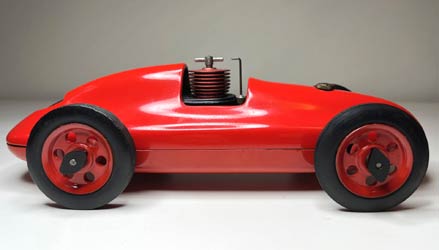
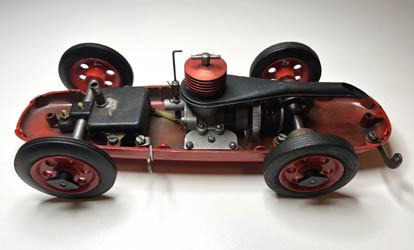
VEB Porsche. This fully panelled tether racing car has a Duroplast body, the composite material developed in Eastern Germany because of the shortage of steel and aluminium. The wheels have rubber tyres and are otherwise also made of Duroplast. The car is powered by a Comet compression-ignition engine from VEB Berliner Aufzugsbau, which was only produced in small numbers. The engine was used in GDR aeroplane, boat and racing car models, all as tethered models. Displacement 2.47 cc, bore 15 mm, stroke 14 mm, speed 17000 rpm, power 0.27 hp, weight 160 grams, here with special standard original exhaust which leads through the body to the rear. The axles are rigid, originally the racing car was a kit. The wheels are screwed on with wing nuts. The car was a product of the consumer goods production of the GDR of the VEB Vorrichtungsbau Hohenstein - Ernstthal. The car was only offered for a few years between 1955 and 1960 and is extremely sought-after and rare. Thanks to NS for the photos and text of this very rare car July 26 |
|
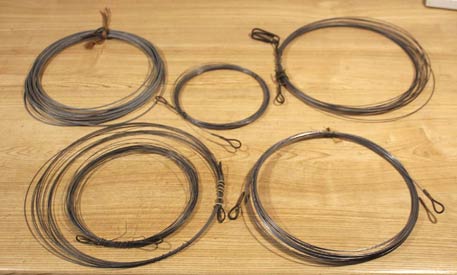 |
Original Tether Cables This selection of cables was discovered in a pitbox where they had remained since the late 1950s, probably from the Blackpool Club. Most are piano wire in various gauges and would not look out of place currently as they are still the same spec as used today for retro cars. Piano wire replaced fibre and shark line, which were prone to stretching and breaking. The thickest line is actually galvanised, multistrand wire, almost certainly for the 10cc cars and certainly not acceptable now. The only noticeable change has been the way the ends are wound and soldered. OTW photo June 2026 |
 |
 |
 |
| Another Electra Pioneer
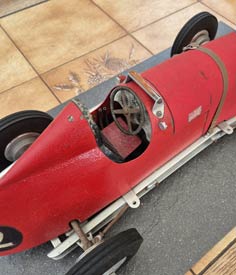
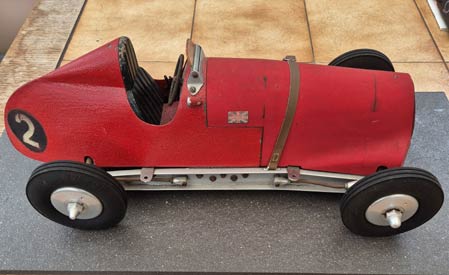
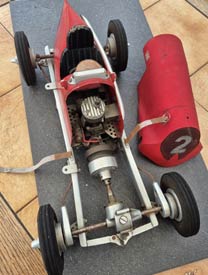
Buck 2/2A Gerry Buck's #2 was conceived for the Aeromodeller competition in 1943 and way ahead of the other entries in design, construction and performance. It morphed in to 2A after being seriously deranged when the tether cable broke on an indoor track. The car, with its Bunch Gwin motor, achieved many speed 'firsts' setting records in the process for the next four years. The plans for the car were published in 1945, but as can be seen, the chassis was not easy to form as the channel section was tapered in depth and splayed as well. Sid Smith of Electra Pioneer in Chatham produced a kit commercially for sale with all the chassis parts already formed, including the rear axle steering system. Many of these appear to have been sold as they have turned up in every state from total wrecks to so well made that one respected collector bought one thinking it was the real thing? Engine, gearbox, wheels etc were down to the builder. This one seems to have E&M items dating it to the late 40s. Thanks to Phillip Johnson for this item and photos. May 2026 |
||
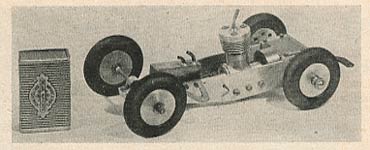 |
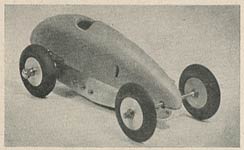 |
 |
 |
| R. G. Cameron's 'Miniature
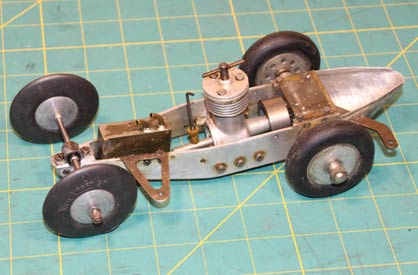
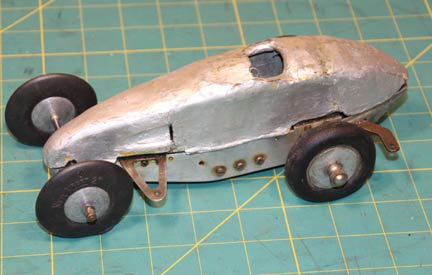
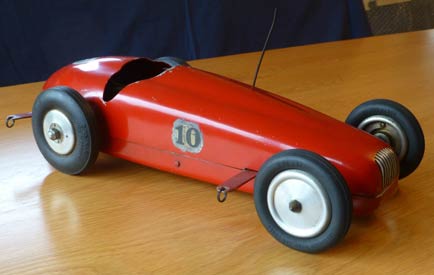
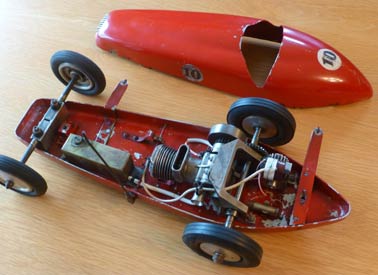
Rapier' Around the end of 1950, Robert Cameron up in Gatehouse of Fleet in Scotland, who was something of an authority on tuning Rowell motors for speed flying, bought a new Rapier car from Wilf Rowell. Minor problem was that it had no engine and no immediate prospect of delivery. Robert's young son saw the Rapier and said that he wanted one as well, prompting his father to build a half sized replica around an ED Bee 1cc diesel. The finished car was featured in a full page article in Model Maker in March 1951 with Cameron describing the body as made from papier mache, although it appears more like glued paper strip. The concluding paragraph from Cameron indicated that he would be making a beaten aluminium body, similar to the full sized car to replace this. Well, 76 years later and we can see that never happened, although the tail piece of the pan is formed from sheet aluminium. Photos OTW April 2026 |
|
 |
 |
| Unusual 1066 Conquest
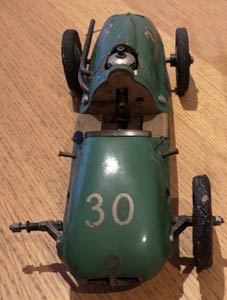
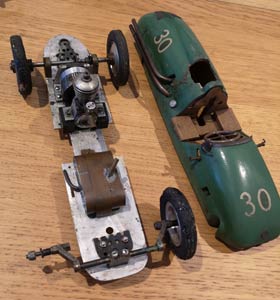
At first glance this is a pretty standard
Conquest, except it is the only one we have seen rigged to run clockwise, much better for
the fuel feed to the rear venturi, but also requiring a new and non
standard tank. 1066 Heavy Duty front wheels but ZN semi pneumatic rears.
Most example of the Conquest are coil ignition, but this one has
a magneto driven off the spur gear. The ignition knock off runs
across the whole width of the car with the lever on the left and
the switch on the right. |
|
 |
 |
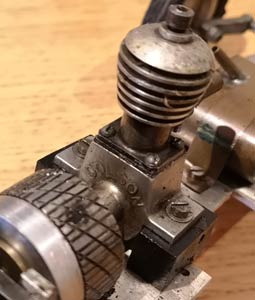 |
| Ransom 'Rhiando Trimax' Alvin 'Spike' Rhiando, who apparently also went by a variety of other names, was a speedway rider before moving in to 500cc F3 racing after the war. After successes with a Cooper car he set about building a car of his own that was both 'advanced and innovative'. He planned to use it with engines of 500, 1,000cc and 2 litres, hence the 'Trimax' name. It was raced from 1950 onwards before being sold to the US. In 1953, NLSME club member Bill Ransom, built this replica for rail racing. The motor is a 1cc Weaver/Ransom sideport diesel, designed by Arthur Weaver and drawn up by Bill. This was the first engine Bill had ever built, but the Colson name cast in to the crankcase reveals a bit more of the engine's history. When construction of the engine was first described in Model Maker it was entirely built from bar stock but it was indicated that if there was sufficient demand, a casting would be available for the crankcase along with other components, now known to be supplied by Colson. |
||
|
The 'Trimax' railcar features in several articles and was photographed on the Rex Hays track at the Model Engineer Exhibition. Nothing further was seen of the car until it turned up, along with another chassis in 2025.
The full sized version is described in
detail in Model Maker March 1951 and was returned to the UK in
2007, extensively restored and can now be seen at Vintage race
meetings.
Right: Bill Ransom with Trimax in 1953 |
|
 |
|
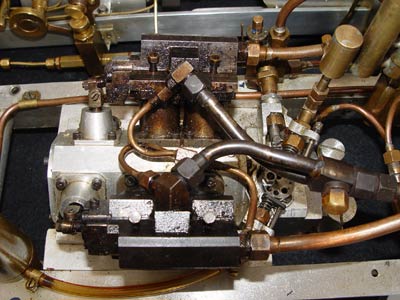
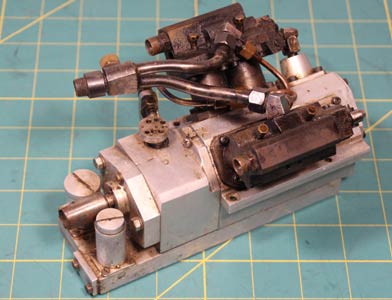
| Arthur Cockman's V4 flash
steam motor Arthur
devoted almost his entire modelling career to steam powered
models, the famous 'IFIT' flash steam hydros, straight runners
and latterly traction engines. His flash steam motors became
increasingly complex with the twin fitted to some of the later 'Ifits'
and this V four in
his straight runner
'Guinivere'. The boat
was sold at auction in 2005 with a plan for its restoration. The
quad fuel, oil and water pumps that also served on
'Ifit 9' were
reunited with the hydro, as included in the restoration plan was
conversion to electric RC pumps. As it transpired this never
took place as the boat was subsequently passed on, minus its
steam plant that was to be repurposed, leaving the V four now
surplus to requirements. It was therefore a great surprise when
a lump wrapped in a piece of curtain material was handed over so
that it could sit alongside the twin that had been salvaged many
years previously. |
|
©copyrightOTW2026